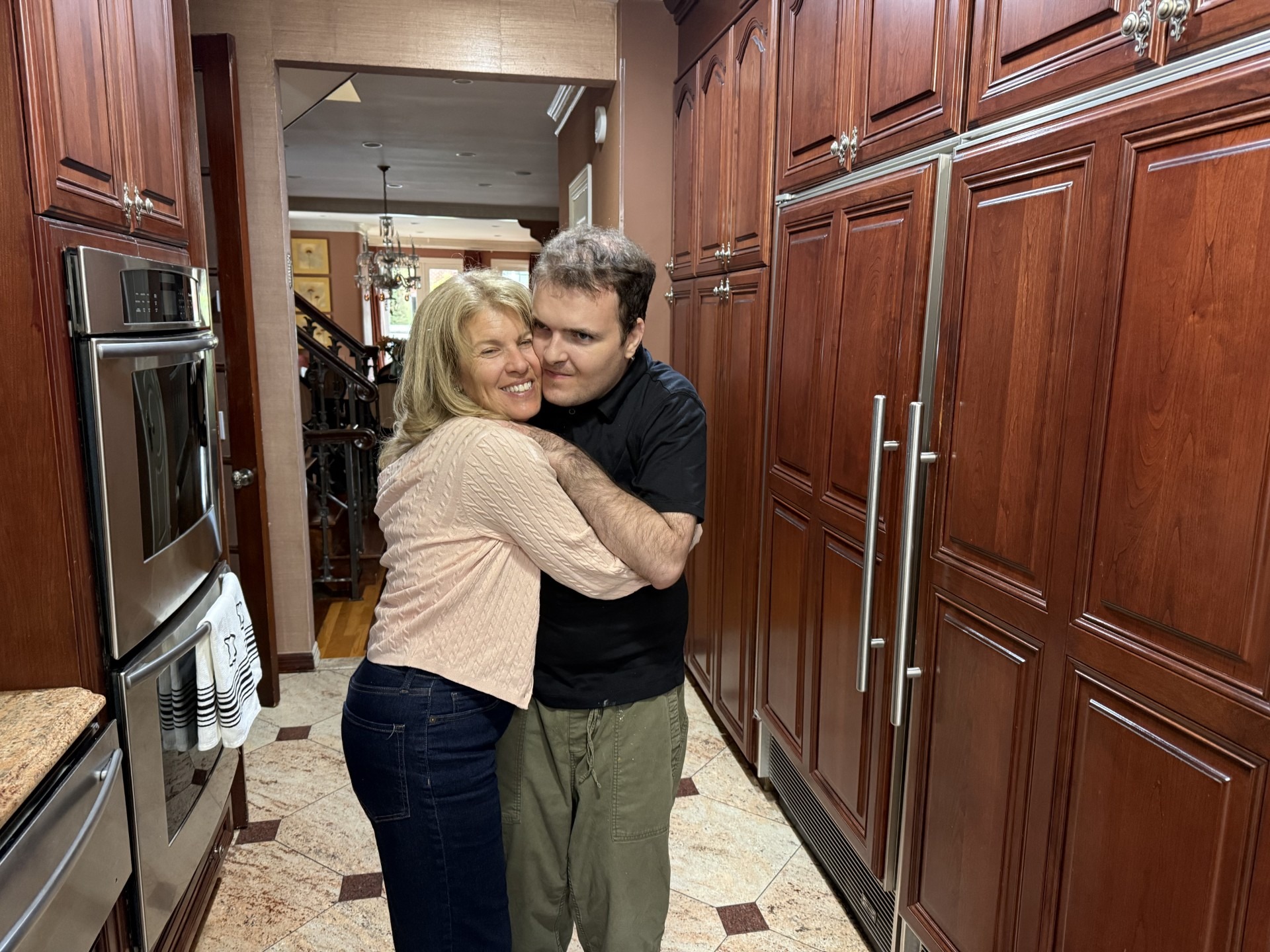
Heather is the mother of four adult children. Her son Phillip, 27, has non-speaking autism and lives just a few blocks from his parents’ home in Brooklyn. With one-on-one support, he spends his days engaged in his community and enjoys a fulfilling life.
But the path to get there was anything but easy. For years, Phillip lived at home with his family, until adulthood brought unexpected challenges. What followed was a six-year journey to find the right living situation and support system to meet his needs. Throughout it all, Heather advocated tirelessly to help her son build the life he has today.
Keep reading to learn about Heather’s experience as a caregiver and an advocate.
Early Years & Diagnosis
When did you first learn about Phillip’s disability, and what was that experience like for you and your family?
Philip is a triplet, and he and his sisters were born prematurely. I was a new mom. I didn’t have any experience or any questions to ask, really, other than the health-related ones. And a social worker told me that my children would be entitled to early intervention services because of concerns about reaching their milestones. So I immediately got on that, and we had a revolving door of many, many, many therapists in my home for, believe it or not, the first three years. And it was at about the seventeen-, eighteen-month mark that the therapists requested a team meeting. They couldn’t tell me, “Your son is on the spectrum,” but they did recommend that we have him tested. And so we did. We went straight to one of the best pediatric doctors in the city, and, at that point, after three days of testing, we were given the information that he has PDD-NOS (Pervasive Developmental Disorder – Not Otherwise Specified), which I don’t even think is a term anymore.
I just thought, okay, he won’t go to nursery school with his sisters; maybe he’ll have to take some pills every once in a while, and then he’ll go to the school. Like, I was clueless. And, thankfully, he was in a really good early intervention program. And, as I went there and I saw what was going on, slowly I came to the realization of what this situation was in front of us, but it still didn’t give me the full scope, obviously, of what was ahead of us. But that’s when things became a little more clear.
Who Phillip Is
Can you talk about Phillip’s personality and behaviors growing up and how that changed as he got older?
At his core, he is an extremely loving, happy, personable person. He is a smart person. He is fully aware of a good vibe and a bad vibe. Cognitively, he understands a lot. He makes his needs known. He expresses himself, although he’s non-speaking. If you meet him and he likes you, or he doesn’t, you will know. He won’t give you the time of day if he doesn’t like you. And if he does like you, he’ll hold your hand. He’ll put your hands on his head. He’ll bring you to what he might want or need. And it’s very clear how he feels. And, you know, that is still to this day, the pleasure and the beauty of my son.
When he was younger, he definitely exhibited signs of self-injurious behavior, but it was very mild. He would bite his shirt, he would dig his nails into his hands, but nothing more than that. And then it was around age 17, he started to hurt himself, but not consistently. We were so in it that it didn’t even phase us. I mean, we knew it was not appropriate and must have hurt a lot, but we weren’t concerned. We knew it would stop and we’d get our Philip back. He’d have ten fabulous months and then he’d wake up one morning and boom, it started and it would last an indefinite amount of time. A week, a day, a month; we never could gauge it, but then it left the way it came.
When Crisis Hit
Then, when he turned 21—exactly the month he turned 21, which was [March of 2020]—that’s when everything blew up. His ears, his jaw, his cheekbones—and only his face—and his face is beautiful, so the fact that he did that to himself… It came out of nowhere, and it never stopped at that point. And COVID exacerbated everything. My husband and I anchored ourselves to either side of his bed for about seven weeks, literally around the clock. We all took shifts. My kids would relieve us here and there, just to hold his hands down so that he would not hurt himself. Talking about it and saying it out loud, it sounds so like, “Oh, my goodness gracious,” but we didn’t know what else to do.
We were working with a psychiatrist. He kept advising us on medication. It would work for a minute; it would work for a day. Phillip eventually wound up in a psych unit because there was nowhere else; that was our only resource. [The psychiatrist] had a colleague in Mount Sinai in Manhattan, and he said, “I don’t know if this is right, but this is the only thing I can think of.” So there we went. I just impressed upon [Phillip’s care team], over and over and over again, that what they see in front of them is not the person he is, and that we didn’t know what to do, and we knew they didn’t know what to do. I had such a strong team surrounding my son, supporting him, helping him, and nursing him back to himself.
When he first went to the psych unit in Mount Sinai, they found a program that was for special needs people, a pilot program in Kings County Hospital in Brooklyn. And we sent Philip there, and there was a wonderful doctor there as well, a brilliant doctor, and he really helped us turn things around. Philip was released home to us after being there for about seven weeks. He came home for two days, everything unraveled, and back to the psych unit he went, and he was there for eighteen months. The doctor from Kings County stayed on through the whole eighteen months to be part of the team. He had a really strong team around him, and I was in constant contact with them. It never ended. I didn’t ever let go; I needed everyone at all times to do everything they could to figure things out and help him get through.
Advocacy & Finding Supports
What steps did you take to advocate for Phillip to get more appropriate support?
I wasn’t consciously advocating for my son at the time. I didn’t have a plan. I didn’t know who to call. I had really nothing at my fingertips. I just was constantly on the phone, emailing, “What’s happening?”, “What medication are we doing now?”, “How do we do that?” I didn’t stop talking to anybody that I could think of or anybody who I came in contact with.
When Philip was [in the psychiatric unit] for about eight or nine months, I was sitting outside in my backyard, and the phone rang, and it was an attorney—a Child Protective Services attorney that represented Mount Sinai—who was calling to ask me if Philip was there on his own free will. She couldn’t interview him, so she needed to reach out to me as the guardian. She referred me to someone that specializes in the circumstances Philip was in, and that person led me to another attorney who works for the city, and she connected me to a private law firm who does pro bono cases.
We were constantly pushing to have Philip placed [in a residential setting]. He got two or three placements that I didn’t really want, but I didn’t have to say no because they were proposed and denied all in one breath. I realized there was a packet [with Phillip’s medical profile], and I insisted on seeing the things that were written [in it]. One of the doctors wrote that he has an incurable brain injury, and he’s only going to deteriorate. So that was a piece of why I couldn’t have him placed. He was presented as having all the self-injurious behaviors, but there was no background. The lawyers actually helped me rewrite the narrative so that it looked like my son.
Finally, AHRC said that they would take him. I was over the moon. Initially, they wanted him to live in Queens. [When that did not work out due to an issue with the building], I said, “We live in Brooklyn; he should live in Brooklyn.” So I was able to find the Brooklyn space, and they worked very closely with me to help create a really nice environment for my son. I picked out the furniture, I picked out the color of the room, I picked out where his food comes from, because we follow a kosher diet, so they order exclusively from a kosher supermarket in our neighborhood. Holidays are respected—decorations, celebrating—I mean everything that he needs is covered.
Life Today
How is Phillip doing today?
Good. He is just seven blocks away from us. It’s really wonderful. And it’s the neighborhood he’s used to and he’s around the corner from the school he went to his whole life.
He lives in a residential apartment. He has full-time staff. He has a one-to-one every day for several hours a day to do community outreach. And he actually attends the school he went to for his whole life. He comes to visit frequently. We see each other a lot.
Advice & Reflections
What advice would you give caregivers who may be going through similar situations?
Well, I think absolutely you have to reach out to as many people as you can. Research and find out who is in charge of what, and don’t stop until you get to speak to the key players. And from there, one thing leads to the other. It’s all about networking and having your wits about you and being as strong as you can be. And the truth is, I didn’t see myself as being strong. I just saw myself, you know, in survival mode. Everything had to work out. I was crying every single day, but I had to keep pushing forward and just try my best to do whatever I could to make it right for my son. When you’re in such a circumstance, a crisis circumstance, you cannot stop. You cannot concede. You cannot say, “This is just the way it’s going to be.”
How has being a mother and a caregiver shaped who you are?
That’s an easy answer. It has made me just so much more sympathetic, empathetic, appreciative of every day and my family and the miracle of who they are and what they are. And the truth is, having Philip in our life is the reason that his siblings are as wonderful as they are. Seeing him form who they became as adults, and seeing his resilience and his persistence and his love and his kindness.
You know, there can’t be any nonsense. There can’t be any jealousy. There can’t be any animosity. It just has to be that we love each other, and we all want what’s best for one another, and we have to just keep moving forward. We just have to love and appreciate and see the wonderful things that are in front of us. It’s hard. It’s very, very hard. I’m not going to pretend it’s not hard. It’s really hard, and there’s a lot of emotions. But what was very important to me as a parent was that they all always counted on each other and loved each other and helped each other.
How do you take care of yourself? What support do you rely on as a caregiver?
I don’t know. One of my friends, when we were going through everything with Philip with the psych unit, and I was going there so frequently and with COVID, she said, “How are you not taking medication? How are you not talking to a therapist? How are you not drinking a bottle of wine every day?” And I don’t know, but, for better or worse, I really didn’t do anything to help myself. I definitely went through a dark period and a “crying every day” period and an “I don’t want to leave the house” period, but I don’t know, I talked myself through it.
I have a very supportive husband, and my children are wonderful. I guess I could say the treadmill—I was on the treadmill every day—so that was my self-care. And my children were my self-care—my three other children that I had to be present for, that I had to laugh with, and drive places, and smile with, and have birthday parties for, and all that stuff.
What do you wish people knew about being a caregiver and an advocate?
Well, I know that when you initially get the diagnosis, I personally was clueless. When you’re in the beginning stages, it’s so important not to look the other way, and to look for every resource and every support possible, whatever that looks like, and not to look at it as, you know, a life sentence. There are a range of emotions when you really start thinking about your child’s life, what you thought it would be, and what it might possibly turn into. But you don’t have the luxury of wallowing in your sorrow. You have to have your cries and have your off days, but you have to keep pushing forward as much as you can, because no one’s going to do it for you.
When Philip was initially diagnosed, we got a Care Manager. [I thought], “What’s a Care Manager? I don’t know. Some lady that comes to my house, she asks me some questions, we talk about other nonsense, then I give her a water bottle, and she leaves.” And I didn’t realize how important she was to Phillip’s life, to make sure everything was going well with the Medicaid, and the this, and the that, and all the paperwork. You have to stay on top of it, have a good relationship with everybody. Do nice things for the people that are in your special needs child’s life—buy them a dozen donuts, drop off a cake, give lotto cards if you’re in the supermarket and you see them—anything just to show appreciation. And to make them aware that you are part of your child’s life, that your child has a life outside of that school or program, that they are loved, that they are valued, and that they are more than just the person they care for six hours a day. That connection is extremely important, especially if you have a nonverbal child who can’t express themselves.